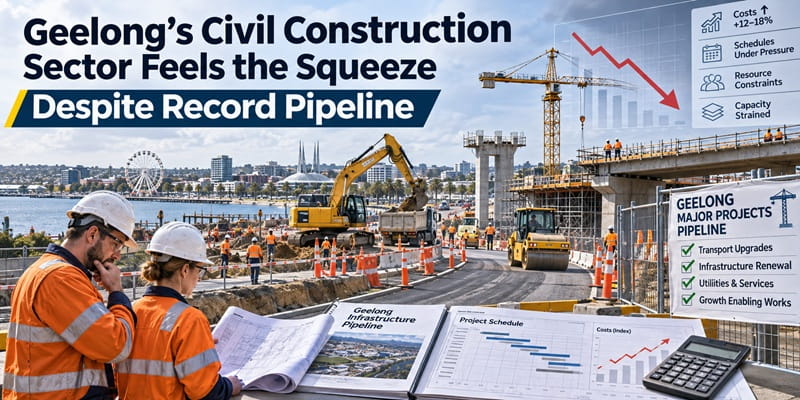
Geelong’s Civil Construction Sector Feels the Squeeze Despite Record Pipeline
Key Takeaways
- Geelong’s construction boom is putting pressure on local civil contractors through rising costs and tighter profit margins.
- Inflation, insolvencies and changing regulations are making project delivery more challenging.
- Competition from larger contractors is making it harder for local firms to win profitable tenders.
- Labour shortages and limited resources are adding further pressure to project schedules.
- Equipment hire, careful cost management and stronger contract terms are helping contractors manage financial risks.
- Long-term success depends on operational resilience rather than simply taking on more projects.
Also Read : AI in Structural Engineering
The totality of Geelong’s civil engineering and construction sector is currently navigating an intensely difficult balancing act, as most civil construction firms and civil contractors in this fast-growing city, about an hour southwest of Melbourne, Australia, are caught in a tug-of-war between a multi-billion-dollar infrastructure pipeline and a compounding wave of regional commercial projects.
Recent projects such as the Nyaal Banyul Geelong Convention and Event Centre, which incidentally is now operational, the South Geelong to Waurn Ponds rail duplication and ongoing roadworks have led to civil construction firms facing challenges ranging from cash flow issues to regulatory shifts, and capacity limitations flanked by scarcity of resources.
Also Read : How Digital Surveying Improves Construction Accuracy
According to construction market analysts, the cost of growth is often flanked by insolvencies and inflation. The fact is that despite robust demand, construction firms, civil and commercial, are feeling the squeeze stemming from thin margins. Construction remains the industry with the most company insolvencies in Australia, accounting for about a quarter of all cases in the 2025-26 financial year.
Coupled with other economic elements such as policy updates and market volatility, rapid expansion within a single industry’s sphere often leads to a cooling period owing to inflation and increasing costs. As far as insolvencies are concerned, this phenomenon is real for small and mid-tier civil contractors, who generally operate on fixed-price contracts that were established when markets were much more favourable.
When regulatory changes and bureaucratic gears are thrown into the mix, everything becomes far more complex and difficult. Compliance and zoning rules that keep getting altered have civil contractors jumping through hoops, as navigating these multi-layered regulations is anything but a ‘walk in the park’, generally requiring extensive administrative overheads that more often than not lead to project bottlenecks.
Apart from inflation, insolvencies, shifting regulations and zoning, the sheer scale of Geelong’s growth has attracted several tier-one contractors into the region, which as expected has made the construction industry fiercely competitive and, for the most part, made it difficult for local firms to secure profitable public tenders.
Furthermore, the sheer number of ongoing projects has also resulted in a shortage of both skilled and unskilled workers. Even though most civil projects use automated machinery, advanced telematics and digital tools, professionals who are competent in technical site coordination are extremely hard to come by, which makes things difficult for project managers, to say the least.
Construction industry players that have long been in the game are leaning towards commercial disciplines to survive and capitalise on the projects that are still in the growth pipeline. This is essential for civil construction firms if they intend to survive: they have to establish buffers to shield themselves from not just current risks, but also future risks.
In other words, these firms should avoid unpriced risks and include stringent clauses that protect them from cost increases. Keeping fixed overheads lean is part of this, with many contractors now working with a Geelong excavator hire company to access machinery as projects demand it, rather than carrying the cost of an idle fleet between contracts.
This is imperative if the civil construction sector of Geelong is to thrive sustainably well into the future. The time has arrived for local civil construction firms to shift their focus away from scale and speed and start paying closer attention to operational resilience and better fiscal oversight.
About the Author
Rajib Dey is a professional Content Writer with a passion for creating engaging, informative, and search-friendly content. He specializes in transforming complex topics into clear, reader-focused narratives that drive engagement and deliver value. With expertise in content strategy, SEO writing, and digital storytelling, Rajib develops high-quality articles, blogs, website copy, and thought leadership content across diverse industries. His commitment to research, accuracy, and audience-centric writing helps brands strengthen their online presence and connect meaningfully with their target audiences. Follow him on Linkedin.
Frequently Asked Questions
1. What challenges are civil construction companies facing in Geelong?
Civil construction companies in Geelong are dealing with higher material costs, worker shortages and tighter profit margins. Competition from larger contractors has also made it harder for smaller firms to win profitable projects. Changing regulations and delays in approvals add to the pressure.
2. Why are Geelong's civil contractors struggling despite growing infrastructure projects?
Geelong's civil contractors are struggling because more projects do not always mean higher profits. Labour and material costs have risen, while many contractors remain tied to fixed-price agreements. Smaller firms also face strong competition when bidding for major infrastructure work, leaving little room to absorb unexpected expenses.
3. Is hiring an excavator more cost-effective than buying one for civil construction projects?
Hiring an excavator is often more cost-effective for contractors who need machinery for specific projects rather than everyday use. It removes the need for a large upfront purchase and reduces the costs of owning equipment that sits unused between jobs. Buying may still make more financial sense for companies that use excavators regularly.